
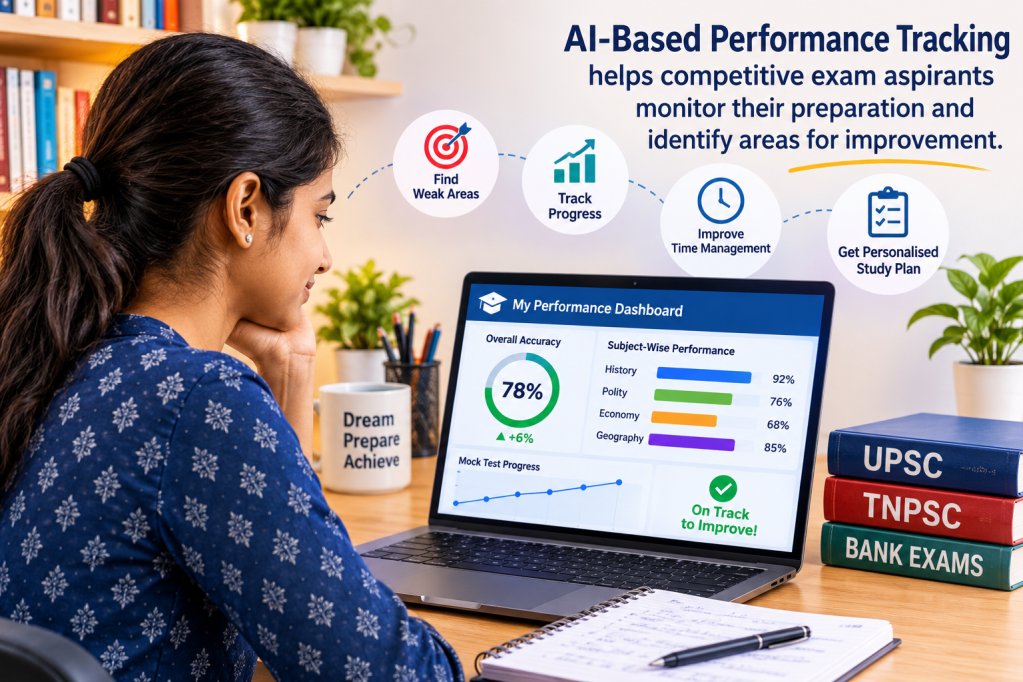
Competitive exams require more than hard work. Whether you are preparing for UPSC, TNPSC, or banking examinations, your success depends on how well you understand the subjects, manage your time, and improve your performance with every test. Many students spend several hours studying every day but still struggle to achieve their expected scores. The reason is often simple: they do not know where they are making mistakes.
This is where Artificial Intelligence (AI) is making a difference in competitive exam preparation. AI-based performance tracking helps students understand their strengths, identify weak areas, and make better decisions about their study plans. Instead of following the same preparation routine every day, aspirants can use performance data to focus on what actually needs improvement.
What Is AI-Based Performance Tracking?
AI-based performance tracking uses technology to analyse a student’s learning activities, test results, accuracy, and progress. It collects information from online tests, practice questions, mock examinations, and learning platforms to provide a clearer picture of individual performance.
For example, imagine a student preparing for the UPSC preliminary examination. The student may perform well in history and geography but repeatedly lose marks in economics and current affairs. An AI-powered learning platform can identify this pattern and recommend more practice in those subjects.
This approach makes preparation more organised. Students no longer need to depend entirely on guesswork to decide what they should study next.
1. Identifying Strengths and Weaknesses
One of the biggest challenges in competitive exam preparation is understanding which subjects require more attention. Students sometimes spend too much time studying topics they already know because those subjects feel comfortable. Meanwhile, difficult subjects receive less attention.
AI-based tracking helps solve this problem by analysing test performance subject by subject. It can help aspirants understand:
- Which subjects have consistently high scores.
- Which topics need additional revision.
- Where repeated mistakes are happening.
- Which question types take more time to solve.
- Whether performance is improving over time.
For example, a TNPSC aspirant may score well in general science but struggle with Indian polity. By identifying this weakness early, the student can adjust the preparation schedule instead of discovering the problem during the final examination.
2. Making Mock Tests More Effective
Mock tests are an important part of preparing for UPSC, TNPSC, and banking examinations. However, simply completing a mock test is not enough. Students must also understand why they received certain marks.
AI-powered performance tools can provide detailed reports after each test. These reports may include accuracy percentage, time spent on individual questions, incorrect answers, and subject-wise performance.
Consider a banking exam aspirant who completes a quantitative aptitude mock test. The student may notice that most mistakes occur in data interpretation questions. The analysis can help identify whether the problem is a lack of conceptual understanding, calculation errors, or poor time management. With this information, the student can practise more effectively.
A useful habit is to spend time reviewing every mock test instead of immediately moving on to the next one. Understanding mistakes is often more valuable than simply increasing the number of tests attempted.
3. Improving Time Management
Time management plays a major role in competitive examinations. Students often know how to solve a question but fail to complete it within the available time. AI-based tracking can analyse how long students spend on different question types. It helps them recognise where they are losing valuable minutes.
For example, in a banking examination, a student may spend too much time solving complex reasoning questions. Performance reports can highlight this pattern and encourage the student to practise faster methods.
Aspirants can use these insights to:
- Set realistic time limits for practice sessions.
- Identify questions that consume unnecessary time.
- Improve speed without sacrificing accuracy.
- Develop better question-selection strategies.
- Monitor progress through regular mock tests.
Over time, students can become more confident about managing the examination duration.
4. Creating Personalised Study Plans
Every competitive exam aspirant has a different learning speed and level of understanding. A study timetable that works for one student may not work for another. AI-powered learning platforms can use previous performance data to suggest personalized study plans. These recommendations may include additional practice, revision sessions, topic-based tests, or changes in study priorities.
For instance, a UPSC aspirant who consistently performs poorly in environment-related questions may benefit from a focused revision schedule. Another student who struggles with CSAT mathematics may need more regular problem-solving practice. Personalised preparation helps students spend their time wisely rather than following a routine that may not match their actual needs.
However, these recommendations should be treated as guidance. Students must still consider the official syllabus, examination pattern, and advice from experienced teachers.
5. Tracking Progress and Building Confidence
Competitive exam preparation is a long journey. Sometimes, students work hard for weeks without noticing any improvement. This can affect their confidence and motivation. Performance tracking provides a measurable way to understand progress.
By comparing mock test results over several weeks, students can see whether their accuracy, speed, and subject knowledge are improving. For example, a student who initially scores 45 marks in a practice test may gradually improve to 60 or 70 marks through consistent preparation. Seeing this progress can encourage the student to continue working towards the target.
It is important to remember that one low score does not define a student’s ability. What matters is the overall learning pattern and willingness to correct mistakes.
6. Supporting Online Learning and Test Preparation
Online education has made competitive exam preparation more accessible. Students can attend classes, access recorded lessons, practise questions, and take mock tests without always travelling to a physical classroom.
When combined with AI-based performance tracking, online learning becomes more useful. Students can use digital platforms to:
- Attend live and recorded classes.
- Attempt topic-wise practice tests.
- Access study materials and revision resources.
- Review mock test performance.
- Track learning progress from one place.
For students searching for an IAS Academy in Coimbatore, it is worth considering how an institution combines classroom guidance, online learning resources, and regular assessment.
An academy should not focus only on completing the syllabus. It should also help students understand their preparation level and identify areas that require improvement.
Institutions such as PM IAS Academy provide a relevant option for aspirants exploring competitive exam preparation in Coimbatore. Students can visit PM IAS Academy to learn more about its courses and preparation support.
7. Helping Students Prepare for Different Competitive Exams
AI-based performance tracking is not limited to UPSC preparation. It can support students preparing for different competitive examinations.
UPSC Aspirants
UPSC candidates can use performance reports to review general studies, CSAT, current affairs, and optional subject preparation. Regular analysis helps them identify gaps before attempting the actual examination.
TNPSC Aspirants
TNPSC candidates can track their performance in Tamil, general studies, aptitude, and other syllabus-related areas. Topic-wise analysis can help them plan revision more effectively.
Banking Exam Aspirants
Banking candidates can focus on quantitative aptitude, reasoning ability, English language, and general or banking awareness. AI-based analysis can highlight speed and accuracy problems in individual sections.
Although the examination patterns differ, the basic principle remains the same: understand your performance, identify mistakes, and improve through consistent practice.
8. Why Students Should Not Depend Entirely on AI
AI is a useful preparation tool, but it cannot replace every part of learning. Competitive exams test conceptual understanding, decision-making, memory, and the ability to apply knowledge. These skills require regular reading, practice, revision, and proper guidance.
Students should also be careful about inaccurate AI-generated explanations or outdated information. For current affairs and examination updates, official sources should always be given priority.
The best approach is to combine technology with traditional learning methods. Teachers provide explanations, guidance, and motivation, while digital tools help students monitor their progress.
Conclusion
AI-based performance tracking is changing how students approach competitive exam preparation. It helps aspirants understand their mistakes, improve accuracy, manage time, and create study plans based on their actual performance.
However, technology alone cannot guarantee success. Consistency, discipline, conceptual clarity, and regular revision remain essential.
Whether you are preparing for UPSC, TNPSC, or banking examinations, use performance analysis as a tool to make your preparation more focused. If you are looking for an IAS Academy in Coimbatore, choose an institution that supports your learning journey through proper guidance, structured preparation, and regular assessment.
Remember, improving your score is not about studying more hours every day. It is about understanding what needs improvement and making every study session count.
Author Bio
Harishma writes about competitive examinations, higher education, and career opportunities for graduates. Through educational articles, she aims to help students understand examination strategies, learning methods, and available preparation resources. Website: https://www.pmias.in/

