
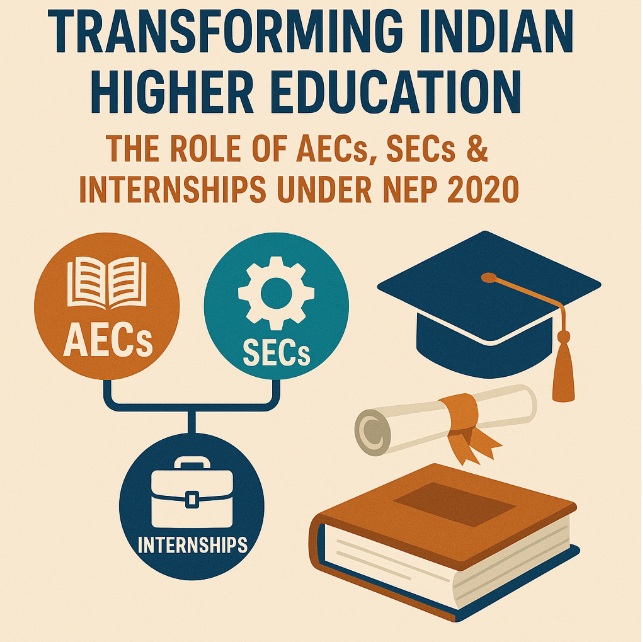
The National Education Policy (NEP) 2020, launched by the Government of India, represents a groundbreaking reform in the Indian education system. Rooted in the vision of transforming the country into a knowledge superpower, the NEP emphasizes holistic, flexible, multidisciplinary education aligned with the needs of the 21st century. One of the key components of this vision for Higher Education Institutions (HEIs) is the introduction and effective implementation of Ability Enhancement Courses (AECs), Skill Enhancement Courses (SECs), and internship-based learning.
These initiatives aim to bridge the gap between academic knowledge and practical skills, making graduates more employable, entrepreneurial, and ready for the real-world challenges. In this comprehensive post, we explore the significance of these components, guidance from UGC and the Ministry of Education, what HEIs need to change, and the broader impact on the Indian education landscape.
Understanding AECs, SECs, and Internships in NEP 2020
Ability Enhancement Courses (AECs)
AECs are designed to enhance communication, language proficiency, environmental awareness, and human values among students. These foundational courses are typically interdisciplinary and compulsory in nature.
Key components may include:
- English/MIL Communication
- Environmental Studies
- Digital Literacy
- Value Education
- Personality Development
Skill Enhancement Courses (SECs)
SECs focus on providing students with industry-relevant, hands-on skills to improve employability. These are often elective in nature and aim to help students apply academic knowledge in practical scenarios.
Examples include:
- Data Analytics
- Foreign Languages
- Photography and Design Thinking
- Cyber Security
- Media Literacy
- Financial Literacy
Internships
The NEP mandates mandatory internships or research projects for undergraduate students. These may be:
- Industry internships
- Community engagement internships
- Research-based projects
- Entrepreneurial incubation projects
These experiences expose students to real-world problems and work culture, thereby enhancing experiential learning.
Policy Support and Guidance from the UGC and Ministry of Education
The University Grants Commission (UGC) and Ministry of Education (MoE) have actively rolled out frameworks to support HEIs in implementing NEP 2020. Prof. M Jagadesh Kumar, Chairman UGC, has said, “The introduction of AECs, SECs, and mandatory internships is a critical pillar in making Indian graduates globally competitive. We are equipping students with not only knowledge but also skills and ethical values. The flexibility and multidisciplinary approach of NEP will ensure our youth are future-ready.”
Furthermore, Dharmendra Pradhan, Minister of Education, has also shared his views on the issue, stating that our vision is to transform India’s education system into one that creates job creators, not just job seekers. Internships, skill-based learning, and value-driven education are central to this transformation. Institutions must adopt these in letter and spirit.
The UGC has released curriculum frameworks and guidelines for the inclusion of AECs and SECs across disciplines and issued advisories to make internships mandatory under the ABC (Academic Bank of Credit) system.
Implementation Roadmap for Universities and HEIs
To truly implement NEP 2020 and integrate AECs, SECs, and internships, HEIs must initiate a cultural and structural transformation in their pedagogy, curricula, and administration.
A. Curriculum Redesign
- Introduce a Flexible Credit-Based System to allow students to choose AECs and SECs based on their interests.
- Adopt multidisciplinary modules for AECs like Environment Studies with hands-on activities and projects.
- Embed practical learning elements and case studies into SECs.
B. Partnership Development
- Forge MoUs with industry partners, NGOs, and startups to offer internships.
- Engage with local governance bodies for community outreach internships.
- Leverage national platforms like AICTE Internship Portal and Bharat Intern.
C. Faculty Training
- Conduct Faculty Development Programs (FDPs) on NEP-aligned pedagogy.
- Encourage blended learning and use of digital tools for AEC/SEC delivery.
- Promote interdisciplinary teaching capabilities.
D. Assessment Reforms
- Move away from rote-based examinations.
- Implement continuous, formative assessment in AECs and SECs.
- Use portfolio-based evaluation for internships.
E. Infrastructure and Systems
- Create a Skill & Internship Cell to manage and track internships.
- Build Learning Management Systems (LMS) to deliver online components of AECs/SECs.
- Ensure multilingual content availability to promote inclusivity.
Progress So Far: Are Indian HEIs Embracing the Change?
Many Indian universities and autonomous institutions have begun embracing these initiatives:
- Delhi University and JNU have adopted SECs and internships under the Four-Year UG Program (FYUGP).
- IITs and NITs have started integrating liberal arts and communication courses as part of AECs.
- Private institutions like Ashoka, Shiv Nadar, and Amity University are embedding internships as graduation requirements.
- Central and State Universities are aligning with NEP’s vision through pilot initiatives with support from UGC.
Yet, challenges remain—particularly in rural or resource-limited HEIs—where faculty, infrastructure, or industry linkage might be lacking.
The Importance of These Initiatives for Students
The real beneficiaries of AECs, SECs, and internships are students, who will emerge as well-rounded, confident, and skilled professionals.
Key Benefits Include:
- Enhanced Communication & Language Proficiency – critical for global placements.
- Job-Ready Skills – relevant to sectors like IT, healthcare, finance, and manufacturing.
- Ethical and Environmental Awareness – building responsible citizens.
- Real-World Exposure – through internships and field projects.
- Improved Employability and Entrepreneurial Readiness
This also aligns with the SDG 4 (Quality Education) goal by ensuring inclusive and equitable learning.
What Needs to Change? Recommendations for HEIs
- Strategic NEP Task Force – Form internal bodies to drive NEP initiatives.
- Curriculum Flexibility – Allow students to craft their learning journeys.
- Budget Allocation – Invest in labs, digital platforms, and internship facilitation.
- Community & Industry Linkages – Build strong local and global networks.
- Policy Alignment – Ensure internal academic policies match NEP goals.
- Tracking Systems – Digitally track AEC/SEC completion and internship credits.
The Bigger Picture: NEP 2020’s Impact on the Indian Education System
NEP 2020 marks a paradigm shift from content-heavy and exam-oriented systems to skill-based, value-driven, and learner-centric education.
Key Transformational Themes:
- Holistic and Multidisciplinary Education: Students can pursue science, arts, and vocational subjects together.
- Multiple Entry-Exit Options: Empowering students with flexible degree paths.
- Credit Transfer and Academic Bank of Credits (ABC): Fostering lifelong learning.
- Technology-Enabled Learning: Use of SWAYAM, DIKSHA, and hybrid modes.
- Focus on Mother Tongue and Regional Languages: Encouraging inclusivity and cultural grounding.
As India prepares for global education partnerships and becomes a talent hub for the world, NEP implementation will play a vital role in shaping the country’s demographic dividend.
Conclusion: A Call to Action
The NEP 2020 initiatives of AECs, SECs, and internships are not merely reforms—they are imperatives for the future. Their successful implementation requires collaboration among government bodies, universities, industry, faculty, and students.
As UGC Chairman Prof. M. Jagadesh Kumar rightly stated: “We are creating a flexible, inclusive, and globally competitive education system. But for this to succeed, HEIs must lead from the front.”
In essence, Indian universities must move beyond compliance and embrace transformation. Only then can NEP 2020 truly revolutionize Indian higher education, preparing our youth not just for jobs, but for life.

